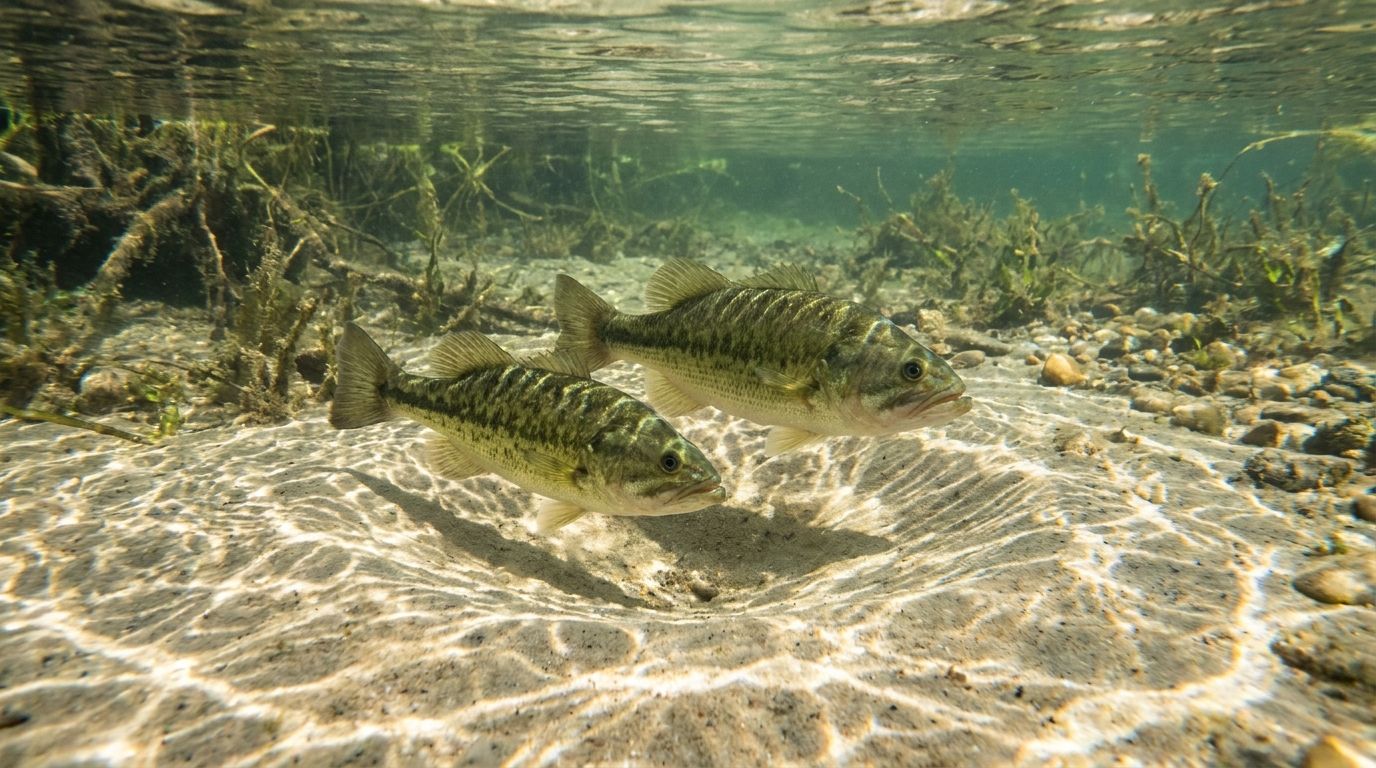
The Three Phases of the Bass Spawn
The term "spawn" often gets used to describe everything from February pre-spawn to June post-spawn, which creates confusion. Breaking it into three distinct phases clarifies both what's happening biologically and what it means for fishing.
Pre-spawn: Fish moving toward spawning areas, staging and feeding aggressively. Covered in depth at The Pre-Spawn Timeline and Finding Pre-Spawn Staging Areas.
Spawn: Active bed building, egg laying, and guarding. This is what this post is about.
Post-spawn: Female recovery and gradual return to summer patterns. See Post-Spawn Bass Recovery.
When and Where Bass Spawn
Temperature Trigger
Bass spawn when water temperature reaches and stays in the 60°F–75°F range. The exact trigger temperature varies by population — bass in southern Florida may spawn at 60°F reliably, while northern largemouth need 65°F+. The duration of the spawn phase (how long individual fish are on beds) also depends on temperature stability.
A warm spell that pushes water to 65°F followed by a cold front that drops it back to 55°F can interrupt spawning temporarily. Fish may not complete the process or may start over when temperatures recover.
Spawning Habitat
Bass are selective about where they build beds. Preferred characteristics:
- Bottom type: Firm sand, gravel, or clay. They avoid soft mud because it doesn't provide stable nesting substrate. Note: this is different from what attracts pre-spawn fish — bedding habitat must be firm.
- Depth: 1–6 feet, most commonly 2–4 feet. Shallower in turbid water (bass need to see the bed), deeper in clear water.
- Cover adjacency: Bass often bed adjacent to or underneath cover — dock pilings, submerged logs, boulders, vegetation edges. The cover provides visual reference and some protection.
- Orientation: South or east-facing banks receive morning sun, warm faster, and often produce earlier-spawning fish than north-facing banks.
- Wind protection: Exposed windswept banks are rarely productive. Bass prefer protected coves, back ends of coves, or wind-shadow areas behind points.
Nest Characteristics
The male fans the bed — a circular depression 12–30 inches across depending on fish size. He clears debris down to firm bottom. The nest is usually visible in 1–3 feet of clear water as a light circle against darker substrate.
The Biology of Bed Fishing
Understanding the biology changes how you think about targeting spawning bass.
Males build first: Male bass arrive at spawning flats before females and build the nest. Early in the spawn phase, you'll find small-to-medium males on beds. Females arrive later and stay for a shorter time (hours to days) before moving off after depositing eggs.
Males guard aggressively: After spawning, the male stays to guard the nest and fry. This protective aggression makes them catchable through the guarding phase — they'll strike baits presented to the bed as threats, not as food.
Females leave quickly: The large female bass — the trophy fish — spend the shortest time on the bed. They deposit eggs over hours to a day and leave. Targeting big females means being in the right place at the right time, which is difficult to predict precisely.
Fishing Strategy During the Spawn
Finding Beds
In clear water, sight-fishing is possible. Work slowly through spawning coves with polarized glasses, scanning for the light circles of cleared nests. Bass on beds are often visible as dark shapes over the lighter nest.
In turbid water, sight-fishing is impractical. Use sonar along shallow flats to find structure features that indicate bedding habitat. Fish the edges of protected flats methodically.
The Sight-Fishing Presentation
When you locate a bass on a bed, the presentation changes from normal fishing:
Effective bed-fishing baits: soft plastic creature baits (4–5 inch), small jigs without trailers, Ned rig, drop shot with craw, small finesse worms. The bait needs to look like a threat — something invading the nest.
Ethical Considerations
Catch-and-release bass angling has a real impact on spawning success when fish are removed from beds repeatedly. The eggs or fry are unprotected during the time a guarding fish is absent.
Responsible bed fishing practices:
- Minimize time the fish spends out of the water
- Release immediately and directly back over the bed
- Limit repeated targeting of the same bedded fish
- Avoid targeting beds in shallow, easily-accessible areas that see very high pressure
This isn't a judgment — it's biology. Make your own decisions with the information.
After the Spawn: What Happens Next
When water temperatures drop below 70°F or fish complete spawning, the process winds down. Females recover in transitional habitat. Males continue guarding fry for 2–4 weeks before also moving toward post-spawn patterns.
Understanding where fish go after the spawn helps you transition before the bite drops off. For the full post-spawn picture, see Post-Spawn Bass Recovery and Swimming Jigs for Post-Spawn Bass.
For the bed-fishing technique in complete detail, see Bed Fishing for Bass. The Prespawn Craw Kit transitions well into spawn-phase fishing with creature baits appropriate for bed presentations.
Spawn biology and ethics covered in depth at In-Fisherman and Bassmaster.