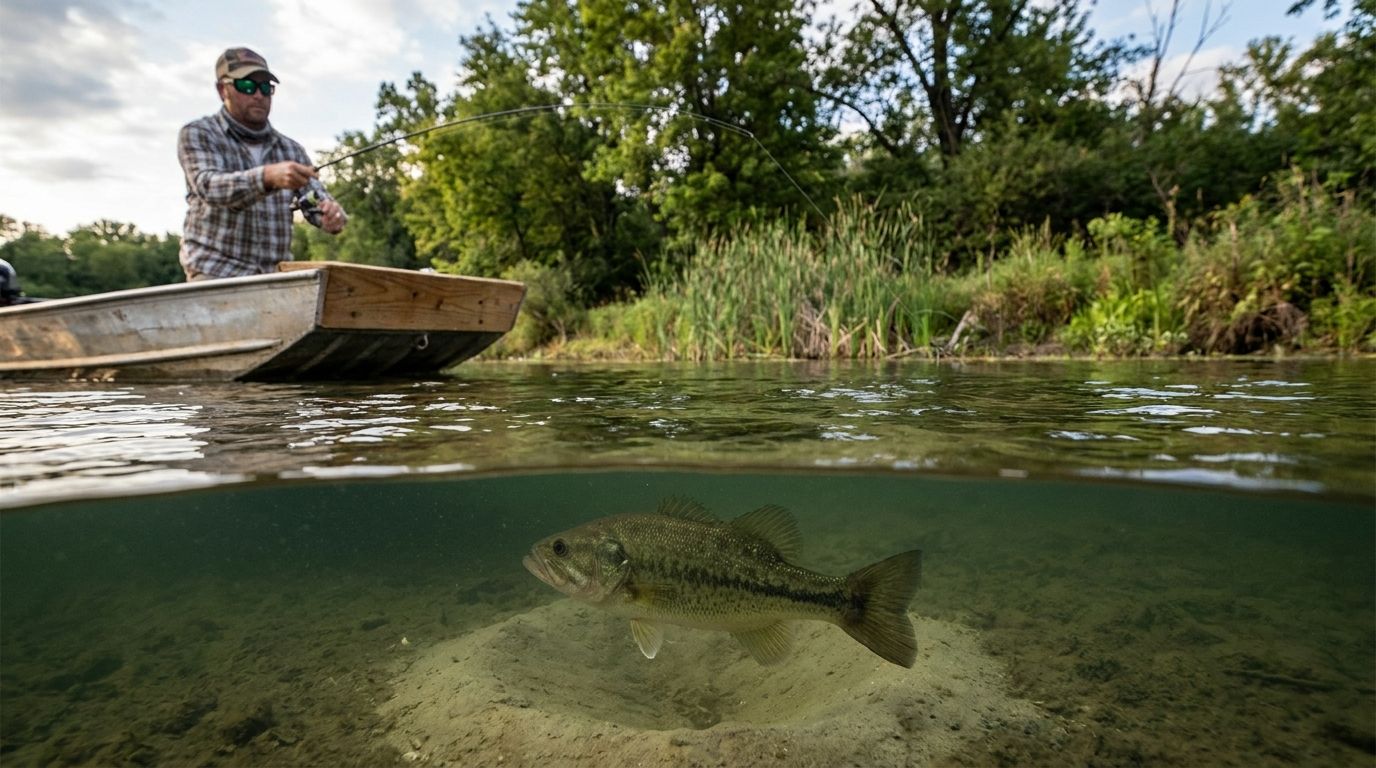
The Unique Challenge of Bed Fishing
Bed fishing is unlike any other bass technique. You're not covering water and triggering reactive strikes. You're locating a specific fish, studying its behavior, presenting a bait precisely on its position, and waiting for it to make a decision that isn't about hunger — it's about territory.
Mastering bed fishing requires polarized glasses, patience, and the ability to read fish body language from a distance. The technical execution is secondary to the observation.
Finding Beds
Visual Searching
In water with 2+ feet of visibility, beds are visible as light circles on darker substrate. Scan slowly with good polarized glasses — amber or copper lenses work well in the shallow water of most spawning coves.
What beds look like:
- Circular cleared areas 12–36 inches across
- Lighter colored than surrounding bottom (because debris has been swept away)
- Often adjacent to cover — dock pilings, logs, rocks, vegetation edge
- The bass itself is usually visible as a dark shape over the lighter nest
Electronics in Low-Visibility Water
In murky or stained water where sight-fishing is impractical, electronics help locate bedding habitat:
- Look for firm-bottomed flats at 2–5 feet adjacent to protected coves
- Mark dock pilings, stumps, and cover features that could anchor beds
- Fish these features methodically — the bass will reveal themselves with a strike rather than through visual observation
What Time of Day
Mid-morning to early afternoon on sunny days gives best visibility into the water column. Morning glare on the water makes early beds hard to see. Overcast days reduce visibility significantly.
Approaching Without Spooking Fish
Electric trolling motor control is critical. Approach beds with trolling motor on the lowest speed. Minimize motor direction changes near fish — the magnetic noise and water movement can spook fish at short distances.
Anchor or stake-out 15–25 feet from the bed rather than trolling alongside it. A staked boat is more stable and less intrusive than constant trolling motor use.
Polarized glasses are mandatory. Fishing blind to a bed you can't see is inefficient — you can't read the fish's response to your bait, which is the core skill in bed fishing.
Bed-Fishing Baits
The bait's job is to look like a threat to the nest — a competitor, a predator of eggs, something that doesn't belong. The bass doesn't eat the bait out of hunger; it removes the threat.
Soft plastic creature bait: The most versatile choice. A 4–5 inch creature bait Texas-rigged weedless, dropped on the bed and left stationary. The appendages move subtly from water current. Craw, creature, and lizard shapes all work. Natural colors often outperform bright colors when fish are pressured.
Small jig without trailer (or with tiny trailer): Clean, compact profile that fits on the bed without dragging over the edge. Light wire hook for better hookup on cautious fish.
Ned rig: A 2.5-inch stickworm or craw on a mushroom head sits perfectly still on the bed, tail quivering from any current. For the most reluctant fish, this small profile often produces strikes from fish that have ignored larger baits.
Drop shot rigged worm: Drop the weight onto the bed and let the bait float above it. More complex to manage but creates a bait that appears to hover over the nest — extremely threatening to a guarding bass.
The Presentation
- Moving away — fish is spooked; wait and let it return
- Hovering with tail waving — fish is interested but cautious; keep waiting
- Nose-diving at the bait — fish is about to pick it up
- Moving the bait off the bed — now set the hook
The hookset: Don't set the hook when the fish first touches the bait. Wait until the fish picks it up and moves with it — this ensures the hook is inside the mouth. A quick hookset on initial contact often misses or catches the fish outside the mouth.
Reading Fish Behavior
Different fish behaviors require different responses:
Fish that ignore the bait entirely: Try a different bait, wait longer, or come back after moving away. Some fish have been targeted multiple times and won't respond. Move on.
Fish that pick up the bait and spit it immediately: Size down. The bait may be too large. Or lighten the leader — fish can feel resistance through the line on light line much better than on heavy.
Aggressive fish that attack immediately: These are the easiest to catch. Drop the bait, wait for the pickup, set the hook. Don't overthink it.
Lockjawed fish that circle but won't commit: A common situation under high-pressure conditions. Try moving the bait very slowly off the bed — the movement sometimes triggers a response. Or wait — sometimes the fish simply takes time. Some anglers report waiting 45 minutes for a single fish.
After the Catch
Release the fish back over the bed immediately. A bass that has left the bed to escape a predator (the angler) may need a moment to find its way back. Return trips to a same bed often produce a second fish — sometimes larger — waiting nearby.
For the biology of what's happening during the spawn, see Understanding the Bass Spawn. For what comes immediately after, Post-Spawn Bass Recovery covers the transition.
Bed fishing technique at a high level from Bassmaster and ethics discussion at Take Me Fishing.