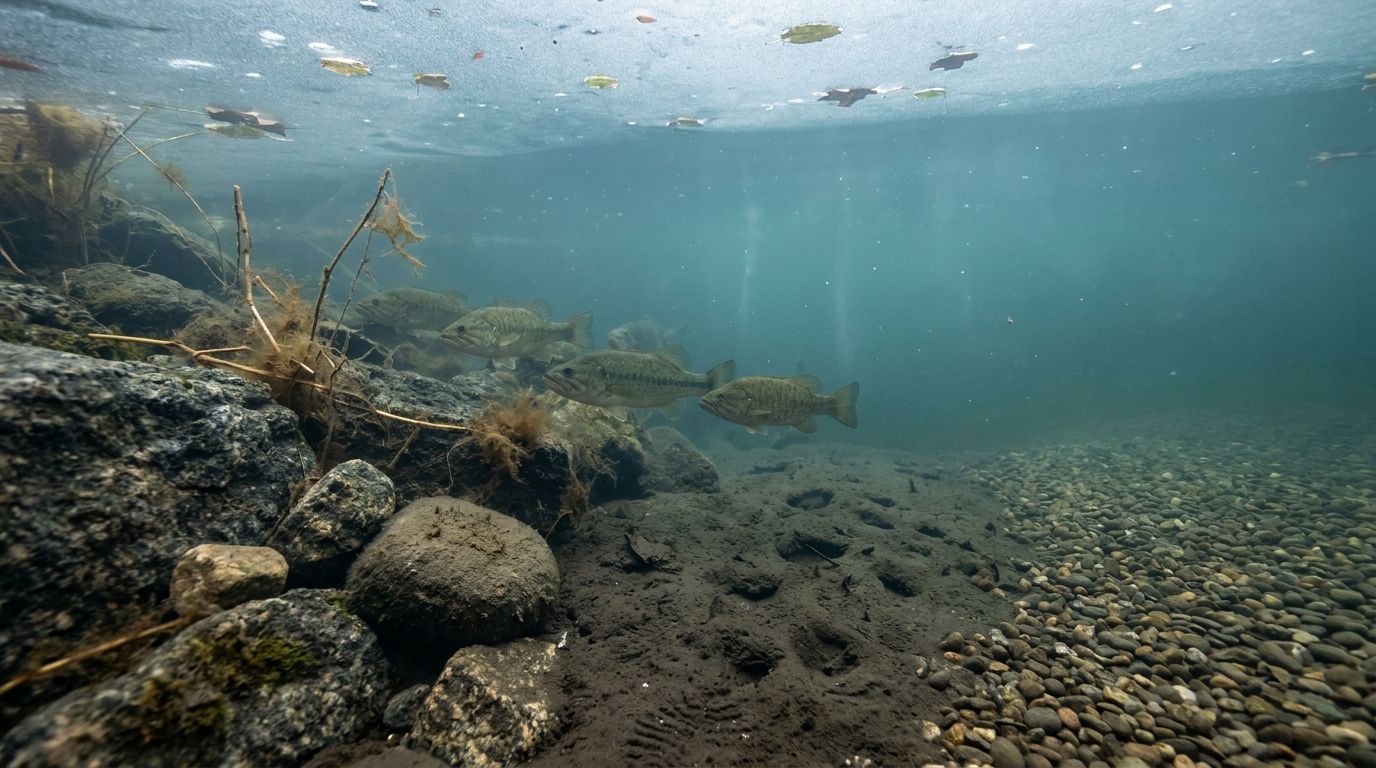
Why Bottom Composition Matters in Winter
In summer, bass relate to cover — grass, docks, laydowns, brush piles. In winter, cover becomes less important than bottom type.
Cold-water bass are looking for two things: thermal stability and forage. Hard bottom — rock, gravel, shell, compacted clay — warms faster with sun exposure and stays warmer longer than soft mud. Crawfish live in rocky and gravelly substrate. Gobies, perch, and other cold-tolerant forage species prefer hard bottom.
Soft mud holds cold water and offers little forage. Bass avoid it in winter unless there's no better option.
Understanding this shifts how you search. Instead of looking for cover, you're looking for transitions — specifically, where hard bottom begins.
Reading Bottom Composition on Sonar
Modern sonar makes reading bottom type accessible, but you need to know what the returns mean.
Hard bottom signatures:
- Thick, bright return line on the bottom
- Strong second echo (the bottom echo appears twice on 2D sonar)
- High intensity color returns on color sonar (typically orange and red on Humminbird)
- Distinct, defined bottom line even at depth
- Thin, dim bottom return
- No second echo
- Muted colors on color sonar (blue/green)
- Fuzzy or indistinct bottom line
The transition between hard and soft is often visible on sonar — you'll see the return change character as you idle over it. Mark those transitions. They're prime winter holding spots.
Down Imaging and Side Imaging for Bottom Detail
2D sonar gives you composition information but not much visual detail. Down imaging shows you what's actually on the bottom.
What to look for:
- Shell beds: appear as irregular bright patches — an underrated winter bass attractor in many southern reservoirs
- Chunk rock: irregular, textured bottom with bright returns between gaps
- Gravel points: uniform, moderately bright bottom that contrasts with the soft mud of adjacent flats
- Roadbeds and rip-rap: extremely bright, distinct returns; bass hold on the hard/soft transition at the ends
Side imaging is most useful for scanning large areas quickly to locate hard-bottom structure before you commit to fishing it.
Mapping and Waypoint Strategy
Don't rely on memory. When you find hard bottom that holds fish, mark it. Build a map of productive hard-bottom locations over the course of a season — in winter, those spots become your first stops.
Good waypoint categories:
- Hard bottom transitions on main-lake points
- Shell bed locations in secondary creeks
- Rip-rap ends where rock meets mud
- Gravel hump tops in 18–30 feet
Many of the best winter reservoirs have been heavily fished for decades, which means productive hard-bottom locations are well known locally. Fishing guides and tournament reports can help you identify which bodies of water have significant hard-bottom structure, even before you run your electronics.
The Role of Temperature
Not all hard bottom is equal in winter. South-facing hard-bottom banks receive more solar radiation than north-facing ones. After clear, sunny days, those south-facing rocky banks can be several degrees warmer than the surrounding water — enough to trigger feeding activity in otherwise lethargic bass.
Fish your electronics in temperature mode on clear, sunny winter days. Look for warm-water pockets adjacent to hard-bottom structure. Even a 1–2°F difference can concentrate bass.
Forage Connection
Hard bottom doesn't just stay warmer — it holds the forage bass need in winter.
Crawfish: Burrow into rock crevices and gravel in winter but become slightly active on warm afternoons. A craw-pattern jig dragged slowly along a rocky bottom on a 48°F day can still produce. See the Prespawn Craw Kit for the right lures.
Gobies and sculpins: Where present, these bottom-dwelling species stay active in cold water and concentrate on hard, rocky substrate. This is a primary reason winter bass in Great Lakes tributaries and northern reservoirs stay on rock.
Shad over hard bottom: Dying shad that sink to bottom in cold water often accumulate on hard-bottom ledges and points — bass know this and cruise those edges for easy meals.
Putting It Together
Winter bass fishing becomes simpler when you think in terms of bottom composition first:
This approach applies on reservoirs, natural lakes, and rivers alike. For how the same principles apply to specific reservoir types, read the Lake Type Bass Forage Guide for context on what each body of water holds.
For winter bass location strategy on deep reservoirs specifically, How to Find and Catch Bass in Deep Winter Reservoirs covers the full location puzzle.
Detailed sonar reading techniques at Bassmaster and In-Fisherman.