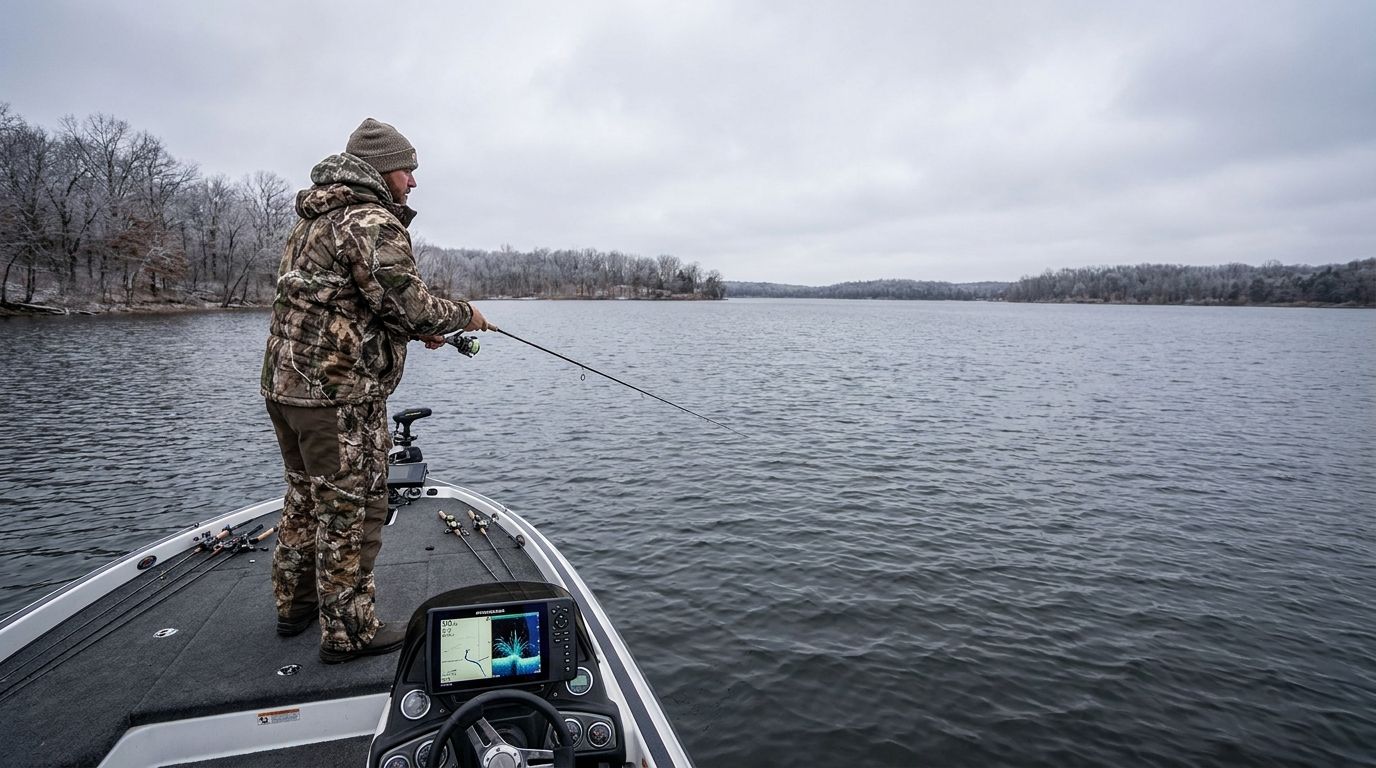
The Deep-Water Migration
Every fall, bass in larger reservoirs undergo a predictable migration. They follow dying shad schools toward the main lake, then drop as water cools. By December on most southern reservoirs, fish that were feeding on 8-foot flats in October are now sitting in 25–40 feet of water, often barely moving.
Understanding this migration is more important than knowing any particular technique. Find the fish first. Then figure out the presentation.
What "Deep" Means on Different Reservoirs
Deep is relative. On TVA lakes like Pickwick or Kentucky Lake, "winter bass" might mean 30–50 feet. On a highland reservoir like Table Rock, it could mean suspended fish at 25 feet over 60-foot water. On a shallow Florida natural lake, winter deep might be 12 feet.
Know your body of water. The consistent factor is that bass position at the deepest appropriate structure available to them — usually the last break point before open-water depths they don't use.
Where to Find Them: Four Key Locations
1. Main-lake points with defined breaks
Points that extend from shore into the main lake are winter magnets. The best ones have a defined step or ledge at 20–30 feet where bass hold off the bottom. Look for any kind of hard-bottom feature — chunk rock, gravel, isolated boulders.
2. Underwater humps and ledges
Mid-lake humps that top out at 18–25 feet with deep water on all sides concentrate fish. Bass use them because they provide both shelter and access to open-water baitfish.
3. Old creek channels where they swing near structure
On many reservoirs, creek channels run through coves and eventually intersect with main-lake structure. Where a channel bends close to a point or hump, you often find stacked fish.
4. Bluff walls adjacent to main lake
On highland reservoirs, sheer bluff walls with irregular ledges hold bass all winter. They position on the irregular features — cracks, indentations, isolated boulders — typically at 15–35 feet.
How to Fish Them
Jigging spoon: Drop vertically on fish you've marked on sonar. Lift 6–12 inches and let it flutter back down. The strike comes on the fall — most often when you've let the spoon rest for 5+ seconds. For technique detail, see Jigging Spoons for Bass.
Blade bait: Works the same way as a jigging spoon but produces more vibration. Effective when bass are slightly more active, water in the 42–50°F range. Read the full breakdown in Blade Baits for Winter Bass.
Drop shot: Set up with 12–18 inches of leader from weight to hook. Lower directly to fish, shake in place. Cold bass that won't chase will eat a shaky drop-shot worm sitting 14 inches off the bottom. See Drop Shot in Cold Water for complete rigging details.
Carolina rig: Excellent for covering bottom along a point or ledge. Cast beyond where fish are marking, drag slowly across the break. Pauses trigger most strikes.
Suspending jerkbait: When fish are in the 15–22 foot range and more active than typical winter bass, a suspending jerkbait fished with very long pauses covers more water and triggers reactive strikes. Full technique breakdown at Winter Jerkbait Fishing.
Electronics and Positioning
Winter reservoir fishing without good electronics is guesswork. You need:
- Sonar to mark fish and bottom composition
- GPS to mark waypoints and return to productive spots
- Down imaging or side imaging to see structure clearly
Idle your waypoints before fishing them. If you don't see fish, move on. In winter, bass are concentrated enough that if they're there, you'll mark them.
Position the boat at casting distance over deeper water, fishing up onto the structure. This keeps your approach angles right and prevents spooking fish on the break.
The Right Mindset
Winter reservoir bass aren't aggressive. Two bites per hour can be a great day if those bites are quality fish. Slow down. Trust your electronics. Work a spot thoroughly before leaving — sometimes the second drift over a mark is when the fish finally commits.
The Offshore Deep Shad Kit covers the key lure types for deep winter reservoir fishing. For understanding how water temperature affects bass feeding windows, see Bass Metabolism in Cold Water.
More on finding deep winter bass at Bassmaster and In-Fisherman.