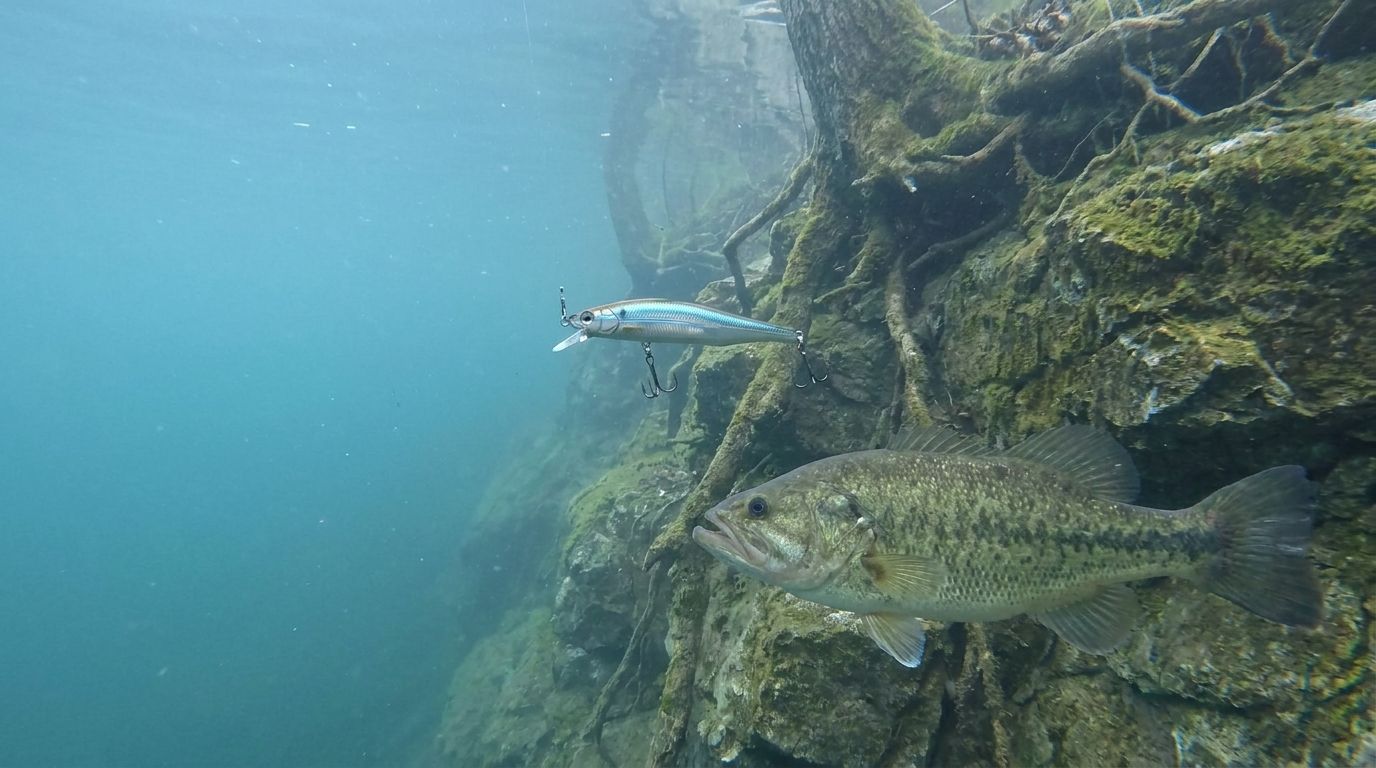
Why Jerkbaits Work in Cold Water
Cold-water bass don't chase. Their metabolism is too slow, their energy budget too tight. But they will strike a bait that sits in front of their face long enough.
That's the jerkbait's advantage. A well-tuned suspending jerkbait hangs motionless in the strike zone — right at the depth of the fish — while you wait them out with long pauses. No other lure does this as naturally.
Water temperatures between 38°F and 52°F are prime jerkbait range. Below 38°F, bass become nearly lethargic and finesse rigs tend to outperform. Above 52°F, they get aggressive enough that other baits often work better. In that 14-degree window, a jerkbait fished with patience can be the best tool in the box.
Finding the Fish First
Winter bass don't scatter. They congregate on specific depth breaks and structural elements near deep water. Your search should focus on:
- Main-lake points with access to 20+ feet
- Channel swings where the river channel bends close to structure
- Submerged roadbeds and creek channels — check your lake map
- Bluff walls with irregular features — ledges, cracks, laydowns hanging over depth
Use your electronics. In clear-water reservoirs, bass in winter are often visible on sonar stacked on bottom in 18–35 feet. Don't fish until you find them — jerkbaits cover water well enough for searching, but knowing where fish are lets you fish smarter.
The Cold-Water Jerkbait Presentation
The retrieve that catches cold-water bass looks almost like not fishing.
Standard cold-water sequence:
In 40°F water, 15–20 second pauses between twitches are not unusual. The strike often comes when the bait has been sitting still for what feels like an eternity. Trust the pause.
Line matters. Fluorocarbon sinks, which drags the nose of the bait down and affects the suspend. Many anglers use 10–12 lb fluorocarbon in winter for the low visibility, but they add small split shot to the belly hook to rebalance the bait's buoyancy after the line change.
Depth Tuning Your Jerkbait
A jerkbait that slowly rises or sinks is fishing at a disadvantage. You want neutral buoyancy — the bait should hang motionless during pauses.
To tune:
- Cold water is denser than warm water, so baits that suspended perfectly in summer may float slightly in winter
- Add small tungsten weights to the rear hook to compensate
- Test in a bucket before you fish
The 6th Sense Provoke 106X Jerkbait is designed with adjustable buoyancy weights, making cold-water tuning much easier than with fixed-weight designs.
Color Selection by Conditions
| Condition | Top Colors |
|-----------|-----------|
| Clear, sunny | Ghost shad, pearl white, silver |
| Clear, overcast | Blue back herring, sexy shad |
| Stained water | Chartreuse shad, fire tiger |
| Cold front post-front | Natural shad, translucent patterns |
In clear reservoirs, match the hatch as closely as possible. Winter shad are often suspended in tight balls — bass have seen the real thing up close all season.
When to Downsize
If bass are visible on sonar but won't commit to a full-size jerkbait, drop to a smaller profile. A 3.5-inch jerkbait fished on 8 lb fluorocarbon with longer pauses often converts suspicious fish. Think of it as the difference between presenting a steak vs. a piece of sushi — sometimes smaller and more delicate is what they want.
For the coldest-water days, the Cold-Front Jerkbait Shad Kit pairs the right sizes and weights to handle February cold fronts without switching rod setups.
For more on seasonal bass locations and forage patterns, see What Bass Eat by Season and Using the Seasonal Calendar.
More jerkbait technique detail from the pros at Wired2Fish and Bassmaster.