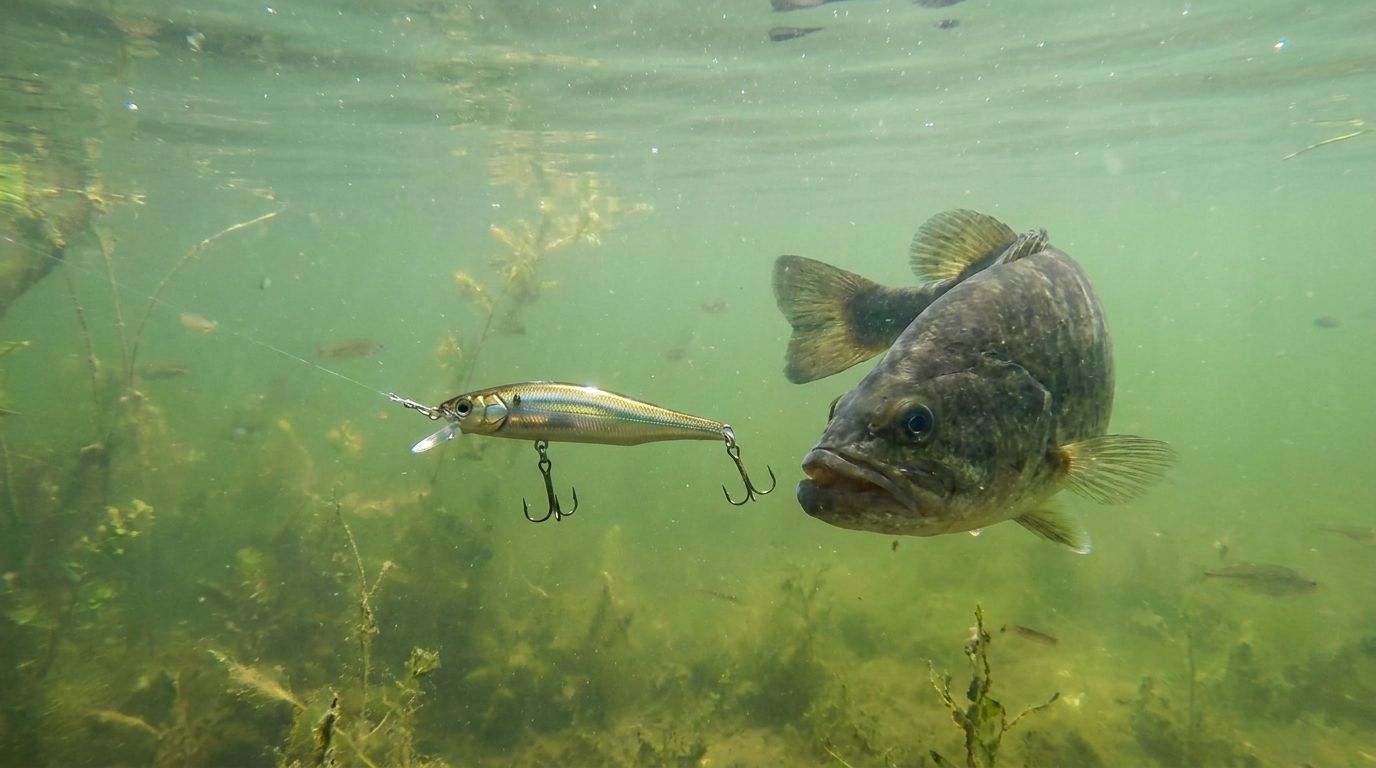
The Jerkbait's Role in the Cold-Water Playbook
There's a temperature window where suspending jerkbaits dominate nearly every other technique: roughly 42°F to 58°F. That's a 16-degree range that covers most of winter in southern reservoirs and extends through early spring across the country.
Why does the jerkbait work so well in that window? It operates at the right depth, stays in the strike zone indefinitely during pauses, and closely resembles a dying or disoriented shad — the primary forage in most reservoirs, and shad that are dying in cold water are exactly what bass are keyed on.
The anglers who master this technique develop an almost unfair advantage during the coldest months.
Jerkbait Anatomy: What Matters
Not all jerkbaits are created equal for winter fishing. The key variables:
Buoyancy class:
- Floating (F) — rises on pause; works in very shallow water
- Suspending (SP) — neutrally buoyant; hangs motionless on pause; this is what you want in winter
- Sinking (S) — sinks on pause; useful for very deep fish but harder to control depth
For cold water, SP models are correct 90% of the time.
Running depth:
Most jerkbaits are classified by lip size and running depth. Common categories:
- 3–5 feet (short lip) — for bass in 5–10 feet of water
- 6–9 feet (medium lip) — the most versatile winter range
- 9–12 feet (long lip) — for deeper winter fish
Match the jerkbait's running depth to where your sonar is showing fish.
Size:
Winter bass — even big ones — often prefer smaller profiles. A 3.5 to 4.5 inch jerkbait in clear water, 4.5 to 5.5 inch in stained water. The 6th Sense Provoke 106X (/products/provoke-106x-jerkbait) at 4.2 inches is an ideal cold-water size with adjustable weighting.
Tuning for True Neutral Buoyancy
A suspending jerkbait that rises even slightly during a 15-second pause is telling fish "I'm not actually dead" — and cold bass often won't chase.
How to test: Fill a bucket with cold water (or use lake water). Lower the jerkbait in and watch it over 30 seconds. It should hang without rising or sinking. If it rises, add a small tungsten adhesive weight near the rear hook. If it sinks, try a lighter hook.
Cold water is denser than warm water, so a bait that suspends perfectly at 70°F may float at 40°F. Retune seasonally.
The Retrieve: Timing Is Everything
The retrieve itself is simple. The timing is the skill.
Standard winter sequence:
In water below 45°F, the pauses extend. Some guides in TVA country are waiting 30–40 seconds between twitches in February. That feels insane if you're used to summer jerkbait fishing. Trust it.
The strike usually comes at second 8 of a 15-second pause — when the bait has settled fully and the last movement has dissipated. The bass has been watching it the whole time.
Reading the Bite
Cold-water jerkbait bites are subtle. You're not going to feel the classic thump of a summer strike. Instead:
- The line goes slack suddenly (fish swam toward you)
- You feel a slight weight when you start the next twitch
- The line moves sideways
- The rod loads up when you thought the bait was sitting still
Keep the rod pointed at the bait during pauses, line slightly taut. Watch the line where it enters the water. Any unnatural movement means set the hook.
Wind and Depth Adjustment
Wind: A chop on the water works in your favor with jerkbaits — it breaks up surface visibility and seems to activate cold bass. Fish into or across the wind. Direct downwind casts are harder to control.
Overcast vs. sunny: In winter, sunny days can be productive for jerkbaits on south-facing structure because the warmth activates bass slightly. But overcast, calm conditions also work well because fish are less likely to spook. Don't overthink weather — focus on finding the right depth and structure.
Depth adjustment: If you're marking fish at 18 feet but your jerkbait runs 6–9 feet, you're fishing above them. Jerkbaits are fundamentally shallower presentations — if fish are below 20 feet, switch to blade bait, drop shot, or jigging spoon. Jerkbaits excel from 5–18 feet.
Early Spring Adjustments (52°F–62°F)
As water warms into the 50s, shorten your pauses from 20 seconds to 8–12 seconds. The bait's action can be slightly more aggressive — three twitches instead of two before pausing. Fish are becoming more active and will chase more.
This temperature range is when bass begin moving from winter deep to pre-spawn staging areas. Jerkbaits cover the transition zones — main-lake points, secondary creek mouths — extremely well as fish stage for the spawn.
For the full pre-spawn story, see The Pre-Spawn Timeline and Staging Areas Pre-Spawn.
The Cold-Front Jerkbait Shad Kit is built around this exact technique — multiple sizes and colors to handle the range from deep winter through pre-spawn.
Technical jerkbait breakdowns from tournament pros at Bassmaster and Wired2Fish.