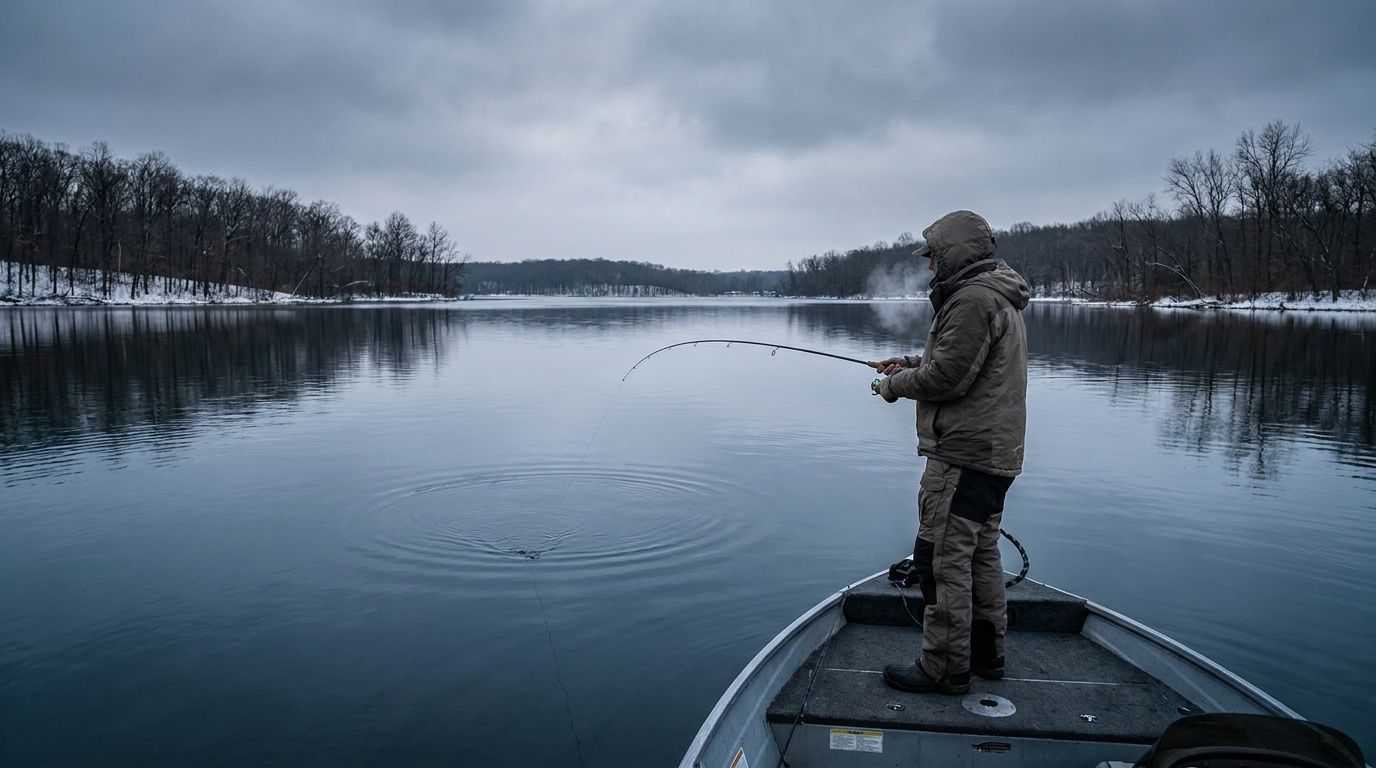
January Expectations
Be honest with yourself before you launch: January fishing is slow. Not slow like a Tuesday in summer — slow like bass are barely moving and have zero interest in expending energy. Bites are few. Trips are short if you're not dressed right. And most of the water you've fished all year is completely devoid of catchable fish.
That's the reality. But here's the other side: January bass are the most predictable bass of the year. They're in specific places that you can find, and they'll be in those same places for weeks.
Where Bass Are in January
Southern Reservoirs (Below the 35th Parallel)
Water temps in January range from 38°F to 52°F depending on latitude, recent weather, and lake depth. Bass are on main-lake structure in 20–40 feet of water.
The most reliable spots:
- Main-lake points with hard bottom — chunk rock or gravel, with the deepest adjacent water within casting distance
- Offshore humps in 20–35 feet — if you marked these in fall, they're even better now
- Bluff walls with ledge features — the irregular face of a bluff concentrates fish at consistent depths
Bass on these spots in January are often tightly grouped. Mark fish on sonar, then fish to them precisely.
Northern Reservoirs and Natural Lakes
Further north, bass are in survival mode. Water below 42°F slows them dramatically. They're in the deepest available stable-temperature zones, often pressed tight to bottom.
Natural lake bass in January (under ice in many areas) are sitting in deep holes, adjacent to points, or along the deepest basin drop. Ice anglers find them in predictable spots year after year.
Open-water January fishing in the north is cold and challenging, but possible on tailwaters and dam discharges where water stays relatively warm.
Small Ponds
Pond bass in January are often more accessible than reservoir bass because ponds are shallow — fish can't go deep. They tend to cluster on the warmest-water sections: south-facing banks that get afternoon sun, dark-bottomed areas that absorb heat, and any inflow areas that might bring slightly warmer water.
See Pond Fishing in Winter for complete small-water January strategy.
Techniques That Work in January
Drop Shot. The most consistently productive January technique across all water types. Lower it directly to bottom, shake in place, and wait. In 42°F water, 30-second pauses between movements are not excessive. See Drop Shot in Cold Water.
Ned Rig. On shallow to mid-depth hard bottom, nothing is more effective than a Ned rig barely inching along the bottom. The floating tail reads like a real crawfish — stationary, defensive, not going anywhere. Bass in January will eat it.
Blade Bait / Jigging Spoon. When you have fish marked at depth on sonar, dropping a blade bait or spoon vertically to their level and jigging in place is extremely effective. The bait goes to the fish; you're not asking them to chase. See Blade Baits for Winter Bass.
Suspending Jerkbait. On warmer January days (water above 46°F), a suspending jerkbait with 15–20 second pauses can trigger fish that the vertical presentations won't reach. Works best when bass are in the 12–20 foot range.
The Mid-Day Advantage
January is the one month where mid-day is often better than early morning. The sun warms surface water slightly after noon, and on clear days that warmth can trigger brief feeding windows on south-facing structure.
Fish mornings on the deeper spots where bass are holding. After noon, check shallower hard-bottom areas with sun exposure — you might catch January's most active feeders in 10–15 feet.
Keeping It Slow
If there's one rule for January, it's this: you're probably fishing too fast. In cold water:
- Slow down your retrieve until it feels impossibly slow
- Then slow down more
- Add pauses where you weren't pausing
- Extend your pauses past what feels reasonable
A bass in 40°F water does not have the same reaction speed as a bass in 70°F water. The bait has to be in front of them long enough for them to recognize it and decide to eat. This takes longer than you think.
Gear and Comfort
January fishing is cold. Hypothermia risk is real on open water in winter. Prioritize:
- Flotation-rated bibs and jacket (stays warm even wet)
- Chemical hand warmers for reel handling
- Fleece-lined gloves with fingertips cut for hook rigging
- Insulated, waterproof boots
Fish shorter trips in worse conditions — three focused hours beats eight miserable ones.
The Seasonal Fishing Calendar shows when January patterns typically peak in your region, and the Fish Finder helps match the right lure to conditions. For the next phase after January, see Finesse Jig Cold Water.
Cold-water bass behavior explained in detail at In-Fisherman.