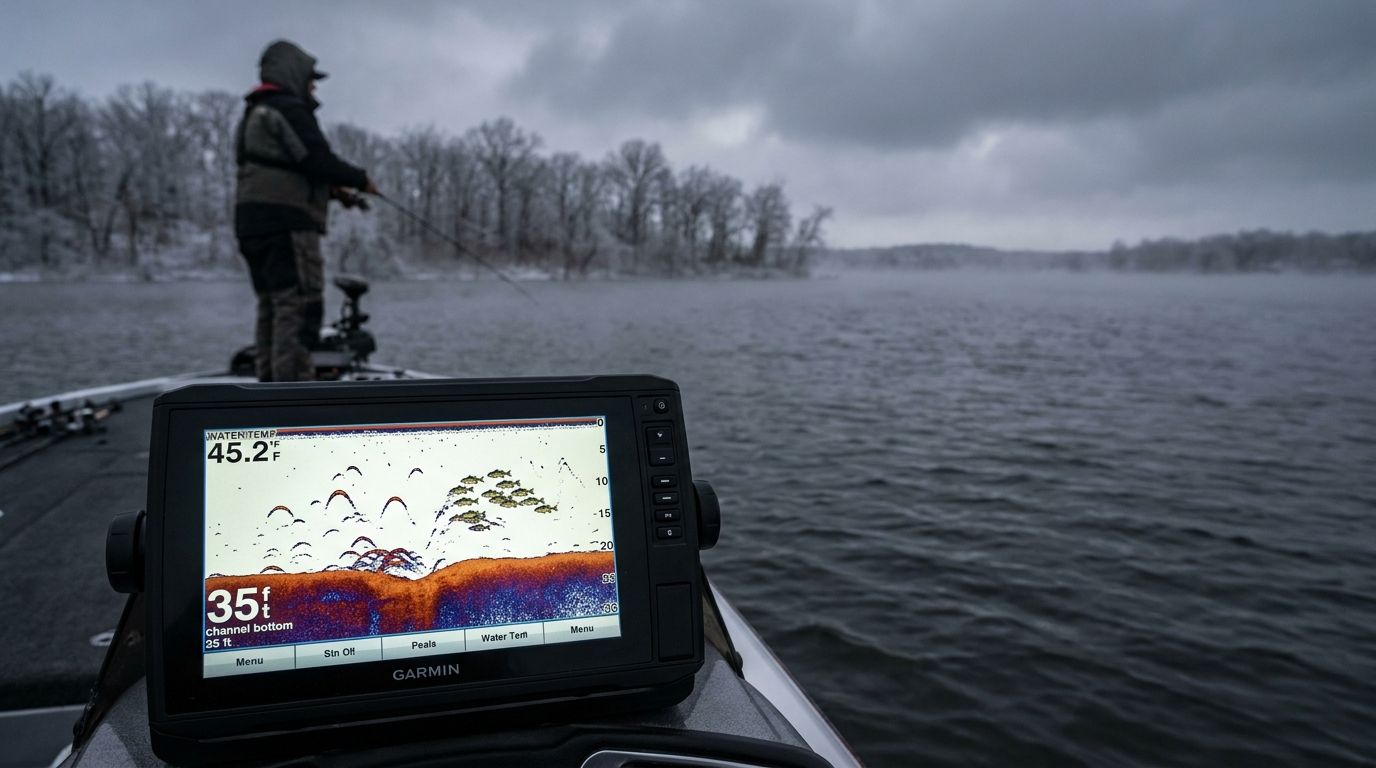
Electronics First, Fishing Second
In summer, you can catch bass by fishing likely-looking cover — docks, grass edges, laydowns — without electronics. Many anglers do it successfully.
In winter, that approach fails. Cold-water bass are in specific locations that rarely announce themselves visually. You can't see a 30-foot ledge from the surface. You can't spot a shell bed. You can't tell whether that main-lake point has rock or mud bottom.
Electronics are the difference between productive winter fishing and random hope. Here's how to use them effectively.
The Search Phase: Idle Before You Fish
The most important habit you can develop is idling structure before fishing it. In winter, the pre-fishing idle is even more critical than in summer.
How to search a main-lake point:
Only after this search phase do you start fishing. If you make three idling passes over a point and see nothing, leave it. In winter, fish are there or they aren't — and they're rarely scattered enough to be "almost there."
What to Look for on Your Screen
Fish Marks
Winter bass on 2D sonar appear as:
- Tight arches close to bottom — classic bottom-hugging winter position
- Horizontal lines just off bottom — suspended fish not moving much
- Clustered marks at a specific depth — a school holding on structure
The arches you're looking for in winter are typically at 20–40 feet. If you're seeing arches at 8–12 feet in January on a large reservoir, it's probably crappie or white bass.
Baitfish Schools
Before targeting bass directly, look for baitfish. Shad schools appear as:
- A fuzzy, diffuse blob suspended in the water column
- Bright return surrounded by softer returns (bait inside with bass behind them)
- On 2D sonar, a layer of returns at a consistent depth
Where baitfish are, bass are nearby. In winter, the bait is often at the same depth as the bass because both are seeking the warmest stable-temperature zone.
Bottom Composition
Hard bottom returns are thick and bright with a double echo. Soft mud returns are thin and dim with no echo. The transition between hard and soft is where bass concentrate.
For a full breakdown, see Reading Bottom Composition to Find Winter Bass.
Using Down Imaging Effectively
Down imaging renders a near-photographic image of what's directly below the boat. It's slower than 2D sonar for finding fish, but better for identifying structure type.
Winter applications:
- Confirming that a point has hard bottom vs. soft
- Identifying submerged brush piles or timber at depth
- Seeing irregular features on bluff walls
- Locating shell beds in 15–25 feet
Run down imaging while idling and use 2D sonar when actively targeting a spot. They serve different purposes.
Side Imaging for Winter Structure
Side imaging shoots sonar to both sides of the boat simultaneously, covering a wide swath of lake bottom on each pass. In winter, it's most useful for:
- Quickly mapping large areas to find hard-bottom transitions
- Locating submerged roadbeds, channel edges, and old foundations
- Finding offshore humps you didn't know existed
- Scanning bluff walls for ledge features
The limitation of side imaging is that depth accuracy for side readings requires math — the distance shown sideways isn't the depth, it's the horizontal distance from the boat at that depth. Learn your unit's display conventions.
Temperature Maps and Water Temperature
Most modern fish finders log surface water temperature continuously as you move. On a full-day outing in winter, you build a surface temperature map of the lake.
While surface temps in winter don't directly tell you what's happening at 30 feet, anomalies matter. Areas where surface temperature is consistently 1–2°F warmer than surrounding water may have:
- Groundwater inflows
- Dark-bottom bays that warm in sun
- Thermal stratification anomalies
Bass in winter seek thermal comfort. Any legitimate temperature difference is worth investigating.
Building a Waypoint Library
Every productive winter spot you find should be waypointed immediately. In cold water, bass return to the same precise locations day after day because the conditions that draw them there — hard bottom, thermal stability, depth — don't change quickly.
Name your waypoints specifically: "NW point rock 28ft bass Jan" beats "WP001." Categorize by season. Your winter waypoint map becomes more valuable every year you build it.
Our Fish Finder Tool pairs well with this approach — use it to match presentations to the structure type and forage you're seeing on your sonar. The Offshore Deep Shad Kit covers the presentations for the depth ranges where winter electronics fishing typically occurs.
More on reading fish finders for bass: Wired2Fish and Bassmaster both publish detailed electronics tutorials seasonally.