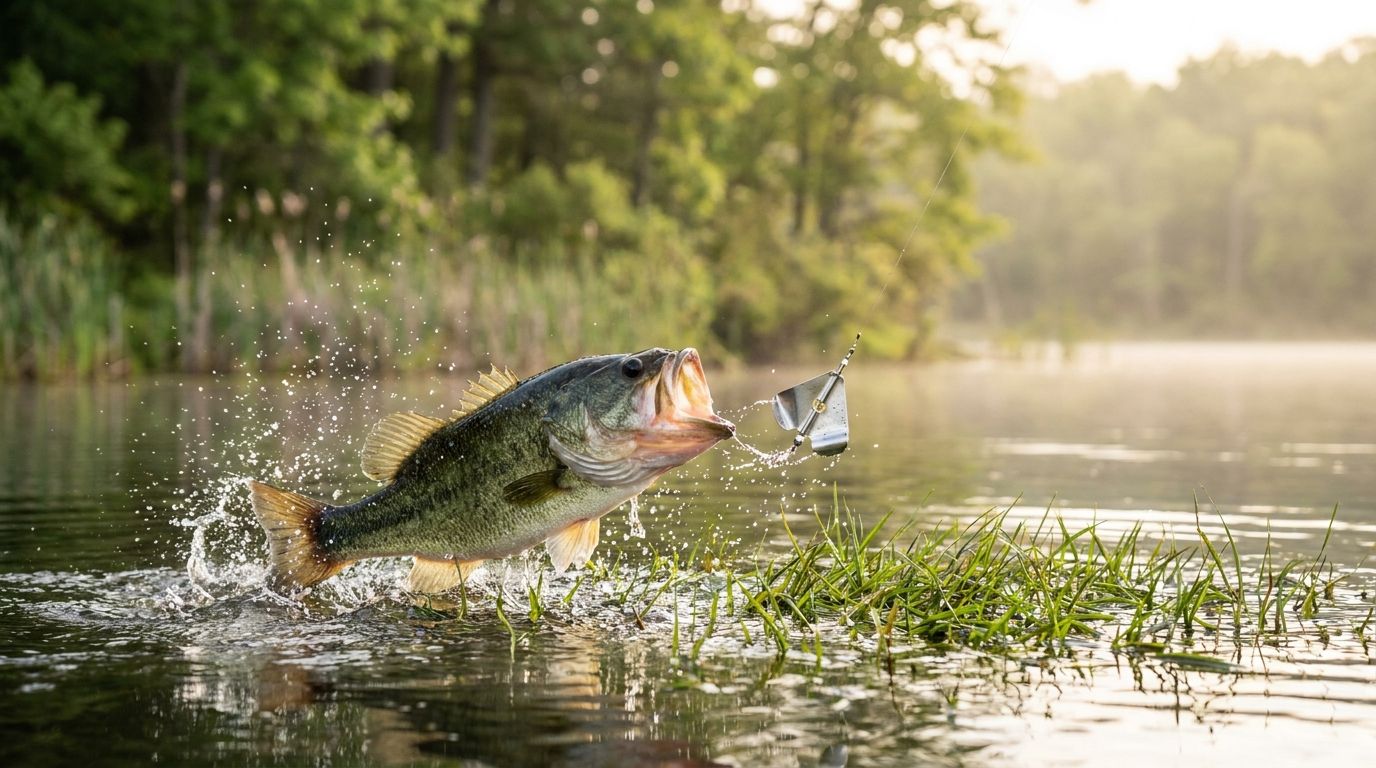
The Buzzbait's Time Window
The buzzbait has a specific season. Fish it in March and you're likely too early in most of the country — water is too cold, bass are too slow. Fish it in July and you're often past the peak in many situations.
The sweet spot: late spring through early summer, typically when water temperatures are running 62°F–72°F. This aligns with post-spawn recovery, the shad spawn, and the bluegill spawn — three conditions that pull bass shallow and make them aggressive enough to crush a noisy, fast-moving surface bait.
Knowing when the window opens is half the battle.
What a Buzzbait Is and How It Works
A buzzbait is an in-line safety-pin style bait with a propeller blade (or blades) attached to the head. Reeled steadily at or just below the surface, the blade creates an irregular, grinding commotion that looks like a struggling baitfish or small creature thrashing on the surface.
Bass strike a buzzbait for two reasons:
Neither requires the bass to be "in the mood." The buzzbait creates urgency. That's its advantage.
Where to Fish a Buzzbait in Late Spring
Vegetation edges: The outside edge of spring milfoil, hydrilla, or coontail is prime buzzbait territory. Retrieve parallel to the edge, staying within 1–2 feet of the grass line. Bass holding just inside the edge will come out to hit.
Dock lines: Work a buzzbait along the edge of a dock row in early morning. Bass stationed in dock shade will come out for a buzzbait presentation when they won't touch a jig or plastic.
Shallow flats adjacent to spawning areas: Post-spawn bass that have moved from the beds to nearby shallow flats are highly susceptible to buzzbaits in the early morning window. Fish these flats at first light.
Rip-rap during shad spawn: When shad spawn along rip-rap at dawn in late spring, the bass activity is intense. A buzzbait retrieved along the rip-rap surface during this window can produce almost every cast.
Laydown lines: Retrieve a buzzbait along the length of a fallen tree or submerged brush pile. When the bait deflects off a branch, it often triggers the strike.
The Retrieve
The standard buzzbait retrieve is a straight, steady retrieve at a speed that keeps the blade barely breaking the surface. The bait should make a consistent gurgling noise — the blade barely in the water, the weight slightly submerged, the skirt trailing behind.
Common adjustments:
- Slower is often better. The slowest retrieve that keeps the blade turning and breaking the surface is usually the most productive. If you're going faster than that, slow down.
- Keep the rod tip up. High rod tip helps keep the bait on the surface at slow speeds.
- Burn it occasionally. After fish have seen the bait multiple times, a sudden speed burst can trigger a reaction strike from fish that were following.
Converting Missed Strikes
Nothing is more frustrating than a massive blow-up that doesn't connect. Several adjustments help:
Trail hook rig: Attach a single trailer hook (soft plastic keeper hook) to the main hook with the point facing the opposite direction. This catches fish that are striking short.
Follow-up bait: When a bass blows up and misses, immediately throw a soft plastic or topwater worm to the exact spot. The fish is fired up — it will often eat the follow-up within seconds. Many guides keep a drop-shot rod rigged alongside the buzzbait rod just for this situation.
Pause on the surface: After a miss, stop reeling for a second, let the bait settle, then resume. Some fish will hit the paused bait.
Blade Styles
Single clacker: One aluminum blade that clacks against the hook arm as it rotates. Loud and irregular. Best in stained water or when bass are aggressive.
Double prop (tandem): Two blades rotating in opposite directions. Smoother sound, more lift on the surface. Better in clear water and for slower retrieves.
Squeaky buzzbait: Some buzzbaits are designed to squeak as the blade rotates on the wire. The squeak is a distinct trigger that some anglers swear by and others find indifferent.
Color and Skirt
- White/chartreuse: The most versatile. Matches shad in all light conditions.
- Black/dark: Low-light conditions, early morning, night fishing.
- Bluegill/green pumpkin: When bluegill spawn has bass feeding on panfish.
- All white: Calm, clear, morning conditions.
Trailer options: a white or natural grub trailer behind the skirt adds to the profile and provides a target for fish that strike short.
For the broader topwater picture in spring, see Late Spring Topwater Fishing. For fishing at night when the buzzbait often extends its productive window, Morning Topwater Bite covers the early-dawn timing.
The Shallow Ambush Topwater Kit includes topwater baits for the full late-spring window including buzzbait applications. Browse the full selection at the Shop.
More buzzbait technique from Wired2Fish.