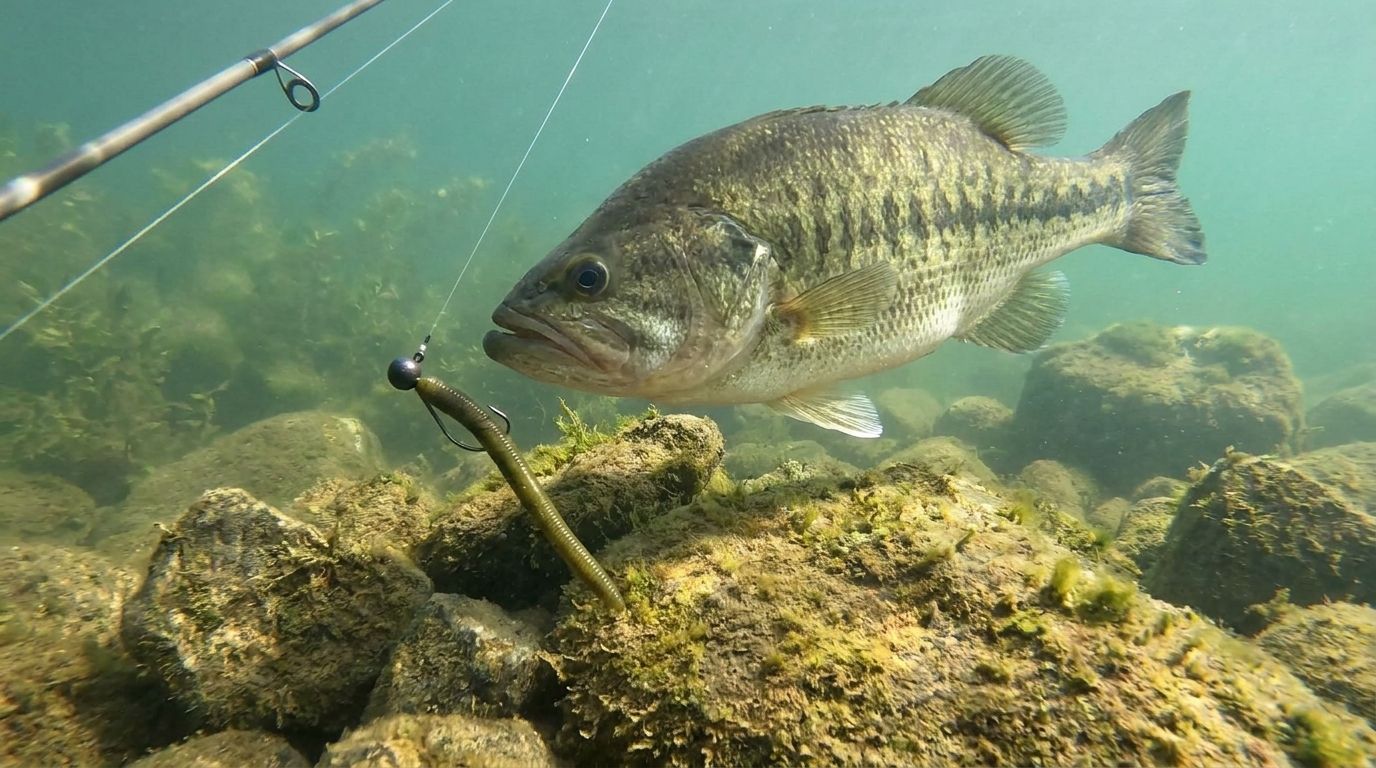
Why Finesse Works on Pressured Pre-Spawn Bass
Pre-spawn is prime time on public water, which means every weekend sees significant fishing pressure on the best staging areas and secondary points. Bass that have been caught and released multiple times in a three-week window become wary. They've seen jigs. They've been spooked by crankbaits. They've been hooked on swimbaits.
The shaky head finesse rig is the antidote. It's subtle enough to fool fish that have been pressured, compact enough to get bites in clear water, and versatile enough to work on every type of pre-spawn structure.
What a Shaky Head Is
A shaky head is a compact, round-ball or finesse-style jig head with a light wire hook — designed for light line and finesse presentations. The head typically weighs 1/8 to 3/8 oz.
The defining feature is the hook angle: positioned to stand the bait upright off the bottom at roughly 45–90 degrees. A straight worm rigged on a shaky head stands up when the jig rests on bottom, quivering in place with any movement. It looks like a worm or creature emerging from the bottom — exactly what a pressured bass isn't expecting to see.
Rigging
Hook: Light wire, 1 or 2 gauge, with a 90-degree bend from the head. The hook point exits 2/3 up the bait and can be buried Texas-style or exposed.
Bait: A 5–6 inch straight-tail worm in natural or subtle colors is the standard. Insert the hook point at the nose of the worm, run it straight through 1.5 inches, exit, and nose-hook the bait so it stands upright. Some anglers add a small piece of scent product to the tail for additional attraction.
Weight:
- 1/8 oz: Very shallow (under 8 feet), calm conditions, lightest spinning line
- 3/16 oz: Standard for most pre-spawn situations (8–15 feet)
- 1/4 oz: 15–20 feet or when wind demands more control
- 3/8 oz: Deepest staging areas or rivers with current
Line and Rod
Light line is essential for the shaky head to work properly. The bait needs to fall naturally and stand up convincingly — heavy line kills the action.
- Rod: 7'0"–7'2" medium-light spinning rod, fast action, sensitive tip
- Reel: 2500–3000 spinning reel
- Line: 8–10 lb braid to a 6–8 lb fluorocarbon leader (18–24 inches)
The fluorocarbon leader is necessary in clear water. Bass on pressured lakes are line-shy.
Shaky Head Retrieve on Pre-Spawn Structure
On Points and Hard Bottom
Cast to the shallowest part of the point or structure. Let the rig sink to bottom — watch the line, bites often occur on the fall in pre-spawn.
Once on bottom:
The shaking on the stationary worm is the main trigger. Worm action entices fish that won't commit to a moving bait.
Swimming the Shaky Head
For covering water more efficiently on flats and ledge tops, the shaky head can be swum slowly:
- Cast, let it sink
- Reel slowly with the rod tip at 10 o'clock, keeping the bait barely off the bottom
- Occasional drops back to bottom, then resume
The nose of the bait points up slightly when swum, giving it a distinct action different from a standard swimbait. Works well on mid-depth flats where bass are cruising rather than holding tight.
Color Selection for Clear Water
In clear, high-pressure conditions:
- Watermelon red / watermelon seed: The near-universal clear-water standard
- Green pumpkin: Slight opaqueness, works in moderate clarity
- Smoke / clear with flake: Maximum translucency for ultra-clear conditions
- June bug (purple/black): Low light, slightly stained water
Avoid bright colors in pressure situations. Clear, natural colors spook fish less on heavily-fished water.
Pre-Spawn Shaky Head vs. Ned Rig
Both are finesse bottom presentations. The differences:
| Factor | Shaky Head | Ned Rig |
|--------|-----------|---------|
| Profile | Longer (5–6 inch worm) | Shorter (2.5–3 inch) |
| Depth range | 6–25 feet | 4–18 feet |
| Coverage | Better for covering water | Better for stationary |
| Best when | Moderate pressure | Highest pressure, clearest water |
When Ned rigs aren't producing on the clearest, most pressured water, switch to shaky head for the longer profile. When shaky heads aren't working, drop to Ned.
Combining with Power Presentations
The shaky head doesn't replace jigs and crankbaits in pre-spawn — it completes the system. Fish power presentations first to locate active fish and trigger aggressive ones. When fish are following but not eating, pick up the shaky head and slow way down in the same area.
This pattern — run crankbait or swimjig to locate, drop to finesse to convert — catches fish that a crankbait-only or jig-only approach leaves behind.
For the full pre-spawn structure picture, see Finding Pre-Spawn Staging Areas and Jig Fishing for Pre-Spawn Bass. The Pond Beginner Kit includes finesse components that work on small-water pre-spawn fish.
More finesse technique from Wired2Fish.