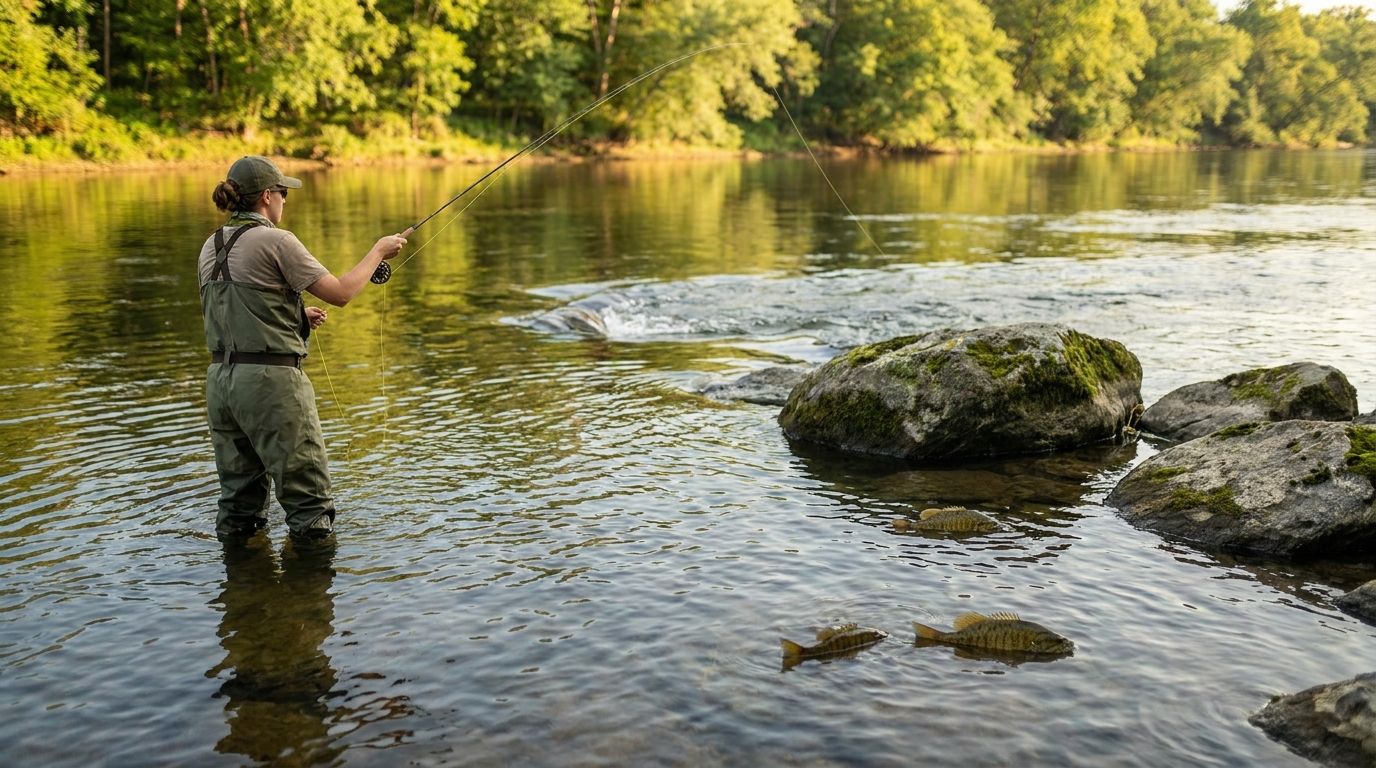
Rivers Are Different
Most bass fishing education focuses on reservoir and lake patterns. Rivers operate on different physics, and the bass in them behave accordingly.
Current is the variable that changes everything. It determines where bass can hold comfortably, where forage concentrates, which presentations work, and how you need to position your boat. Ignore current and you'll consistently fish unproductive water. Read it well and you'll find fish on almost any river stretch.
Reading River Current
Hydraulic Features
Current in rivers is not uniform. It speeds up, slows down, and creates pockets of calm water within high-flow areas. These features determine bass location.
Eddies: Reverse-current pockets that form downstream of current breaks (large boulders, points, bridge pilings). The water circulates counterclockwise in eddies, creating a calm zone where bass rest and intercept food coming off the main current. Eddies are the most reliable bass holding spots in any river.
Seams: The boundary between fast and slow current. Bass station on the slow-water side of a seam and ambush prey carried by the fast current. Cast into the fast water and retrieve through the seam — most strikes come right at the current edge.
Wing dams and rock dams: Structures built to redirect current in navigational channels concentrate bass on both the downstream (eddy) and upstream (current break) sides. Deep scour holes immediately downstream of wing dams are prime bass habitat.
River bends: Current hits the outside of a bend and cuts deep. The inside of a bend (point bar) has slower water and often sand or gravel deposition. Bass use outside bends for the depth and current concentration; inside bends for the slower water and ambush potential.
Structure in River Systems
River bass relate to structure differently than lake bass. In a reservoir, structure is often fixed and permanent. In a river, structure must also provide current relief.
Boulders: Single large boulders create localized eddies. The slack pocket directly downstream of a boulder is bass habitat. Position the boat downstream and cast upstream into the eddy.
Submerged wood: Downed trees and root masses parallel to current create current breaks. Bass hold along the upstream side and in the downstream eddy. Pitching to wood parallel to current, then letting the bait swing into the eddy, is an effective approach.
Bridge pilings: Bridge pilings create substantial current breaks with eddies on both sides. Multiple eddies at different depths — the downstream pocket, the side eddies, the deep scour at the piling base. Each is worth a few casts.
River bends with outside bank depth: The classic river bass location. Deep water at the bank with slower current on the inside. Bass cruise the bend edge for feeding opportunities.
Tributary mouths: Where a tributary enters the main river, a wedge of slower water and often different water temperature (tributary water is often cooler in summer, warmer in spring) concentrates bass. These mouths are spring spawning destinations and summer feeding areas.
Techniques for River Bass
Jig
The most versatile river technique. A 3/8 to 1/2 oz football or arkie jig cast into current, allowed to swing into the eddy, then dragged along the bottom of the slow-water pocket. The current gives the jig a natural swimming action.
In eddies specifically: drop the jig into the eddy pocket, let it fall, drag along the bottom. The counterclockwise current moves the jig without much retrieve effort.
Swim Jig and Swimbaits
River bass in active feeding mode (particularly in spring and early summer) respond well to swimming presentations. Cast into the current and retrieve across the seam — the lure swings naturally from fast to slow water. Strikes come at the seam transition.
The 6th Sense Divine Swim Jig (/products/divine-swim-jig) handles current well due to its compact head design.
Drop Shot
For current-exposed rock piles, bridge piling bases, and anywhere bass are holding below the strike zone, a drop shot positioned into the downstream eddy and held in place covers fish that aren't moving. Heavy weights (3/8 to 1/2 oz) are needed to maintain bottom contact in current.
Crankbait
Crankbaits excel on river points, wing dams, and inside bends where bass are actively feeding. Cast upstream and retrieve downstream — this is the most natural presentation and allows the current to enhance the bait's action. A mid-depth crankbait like the 6th Sense Crush 300DD (/products/crush-300dd) deflecting off rock in 6–10 feet of current is highly effective.
Topwater
River topwater works in predictable windows — dawn and dusk in summer, extended low-light periods in spring. Working a walker or popper along a seam or eddy edge, downstream of a current break, produces strikes from surface-oriented fish.
Current Speed and Bass Activity
Current speed directly affects feeding activity.
Very fast, post-flood: Bass retreat to the deepest, most sheltered eddies. Hard to catch in extreme high water.
Moderate current (ideal): Bass are active on seams and eddy edges. Best feeding conditions.
Slack water, no current: Fish scatter to bank cover and shade, losing the defined current-structure relationship. Approach more like lake fishing.
After a rise: When a river starts falling after a flood, new shoreline cover (newly-flooded brush) is activated. Bass move shallow quickly. This is a short window but can be exceptional.
Positioning
Always anchor or hold position with the trolling motor in a way that lets you present baits across current, not with or against it. Casting cross-current and working the seam is the most natural and productive presentation angle for most river situations.
For the full seasonal context of river bass, see What Bass Eat by Season. The Rock Bank Craw Kit covers the presentations most effective on rocky river structure.
More on river bass fishing at In-Fisherman — comprehensive river bass coverage for all seasons.