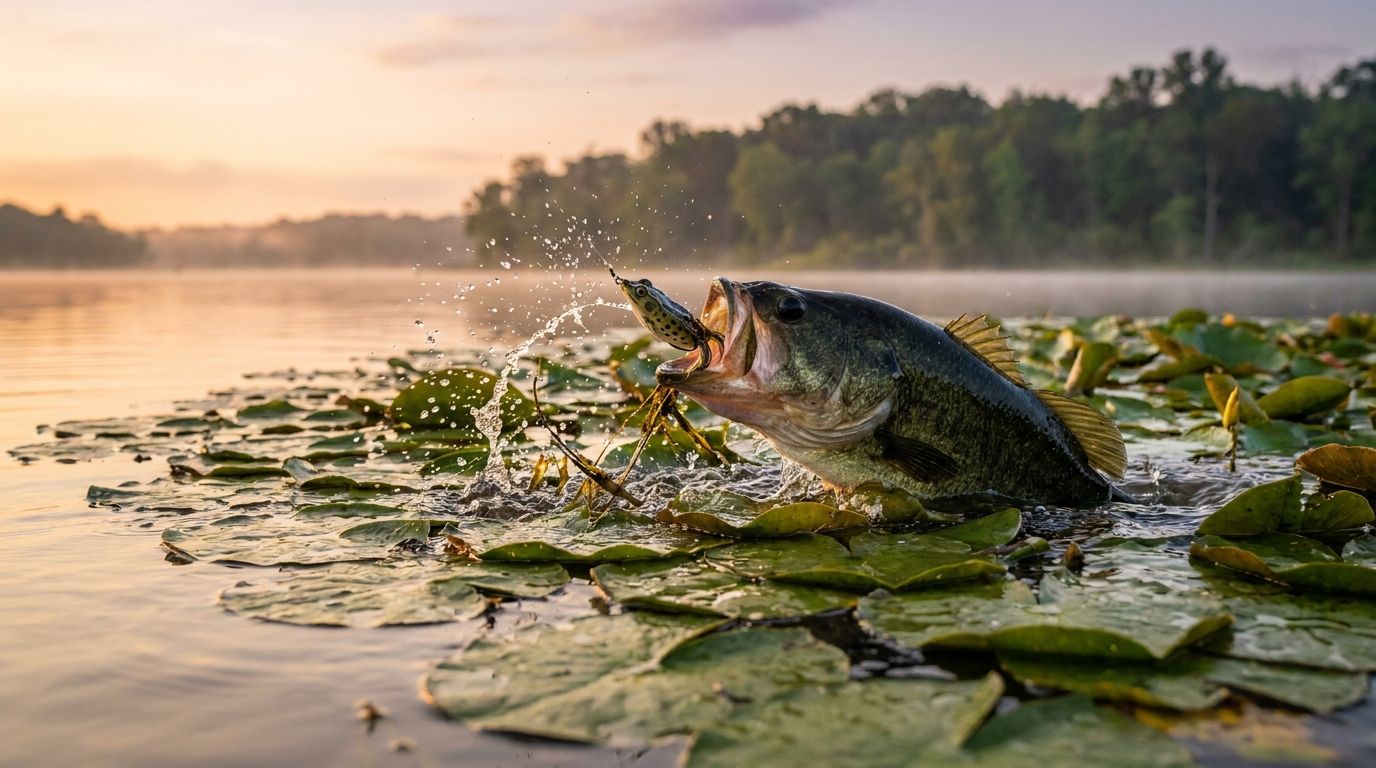
The Case for Throwing Frogs
Few moments in bass fishing match the explosion of a large bass blowing up on a hollow-body frog. But the frog is more than just a fun technique — it's often the only technique that can get into certain areas where bass live.
Matted vegetation, thick lily pad fields, and dense hydrilla mats are impenetrable to virtually every other lure. The frog walks right over the top.
When to Throw a Frog
Prime conditions:
- Water temperature above 65°F (frogs are truly a warm-water technique)
- Visible vegetation mats, lily pads, or emergent grass
- Summer through early fall
- Dawn and dusk (highest surface feeding activity)
- Low-light conditions and overcast days
Frog fishing typically turns on in late May in the South, late June in the Midwest, and stays productive through September–October until vegetation dies back.
The Two BOOYAH Frogs
BOOYAH Pad Crasher — The full-size version for open mat fishing. Use this when vegetation is thick enough to support a larger profile and when targeting big fish. The wider body creates more commotion on the mat.
BOOYAH Pad Crasher Jr — The smaller version is better in open pockets and when bass are being selective. It also skips better under docks and overhanging vegetation. In late summer when bass have seen a lot of frogs, downsizing to the Jr often triggers more strikes.
Reading the Cover
Not all vegetation is equal. The most productive frog areas have:
- Open pockets and lanes in the mat — bass use these as ambush lanes, sitting below a gap waiting for prey to pass over
- Edges where open water meets vegetation — feeding lanes for bass transitioning between cover and open water
- Points of vegetation extending into open water — these concentrate fish
The Walking Retrieve
The standard frog retrieve is a side-to-side walk (similar to a Zara Spook). Keep rod tip low, use short twitches of the rod tip, and let the frog rest in open pockets for 2–3 seconds.
Slow down in pockets. Many anglers walk the frog too fast across open water and then speed up when they hit the mat. Reverse that — slow down over the thickest parts and in pockets.
The Hook Set
Wait. Wait. Wait. The most common frog-fishing mistake is setting the hook the instant you see or hear the strike. Let the fish take the frog, feel weight, and then drive the hook home. Count "one thousand one" before swinging.
Gear Setup
- Rod: 7'3"–7'6" heavy flipping stick
- Reel: High-speed baitcaster (7.5:1+) to take up slack fast on hooksets
- Line: 50–65 lb braided line (no leader — fluorocarbon sinks and pulls the frog nose-down)
The braid is critical. You need zero stretch to drive hooks through a fish's mouth and through matted vegetation simultaneously.
The Bundle
For a complete frog setup, the Summer Mats Frog Kit has both BOOYAH frogs along with a backup topwater option for open-water situations.