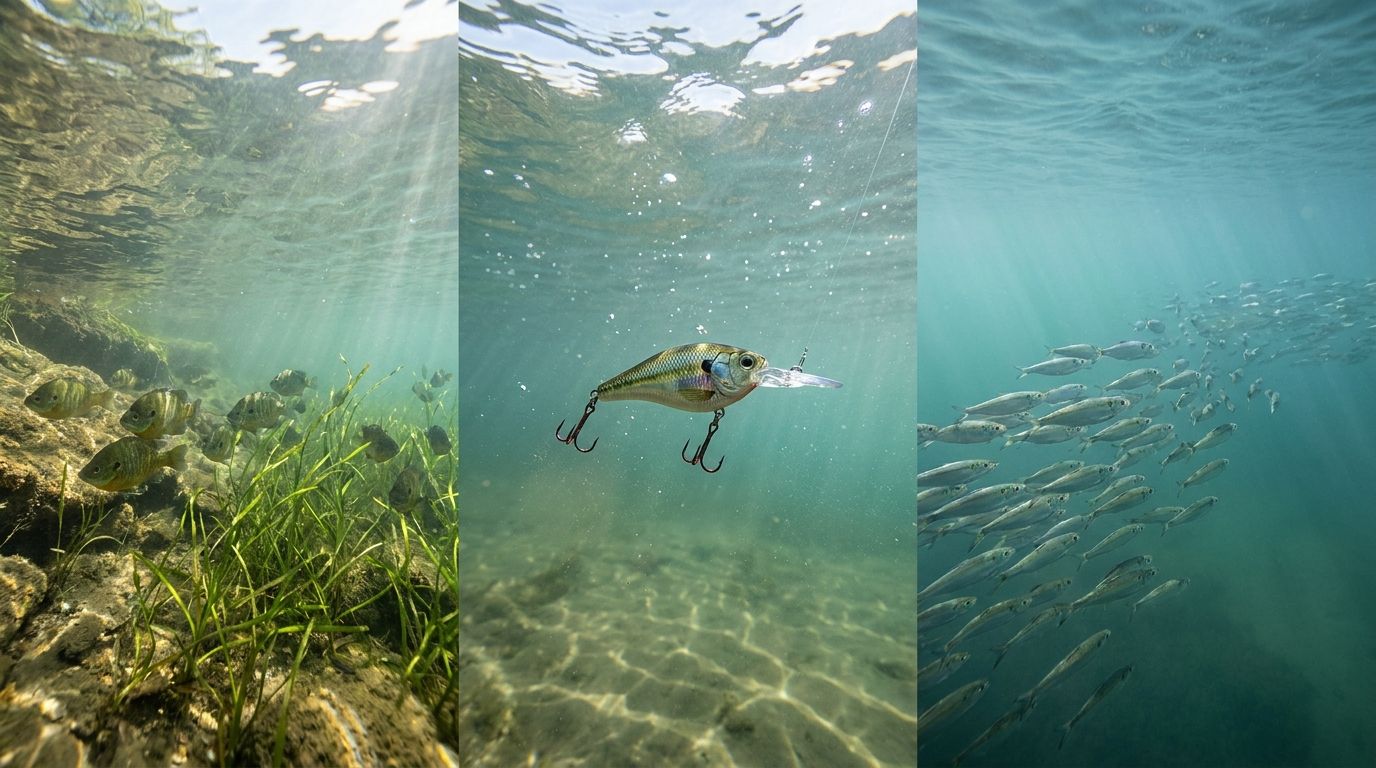
The Two Dominant Forage Families
Walk through the bass fishing world and nearly every technique, lure, and presentation traces back to one of two primary forage animals: shad or bluegill (and their sunfish relatives). Get fluent in both patterns and you can catch bass on most waters, most of the time.
What Makes Shad Different
Shad are schooling baitfish. They move in massive numbers, follow temperature gradients, and create highly visible feeding opportunities — waking, jumping, being pushed by bass to the surface.
Shad characteristics that affect lure selection:
- Elongated, silvery profile → slim-profile lures
- Schooling behavior → covering water to find schools
- Vertical movement (surface to 25 feet depending on season) → variable depth selection critical
- Reaction trigger → fast retrieves often work
- You're on a reservoir in summer or fall
- You can see bait schools (gulls, surface explosions, sonar marks)
- The water is stained (shad with rattle lures)
- It's fall anywhere on major shad fisheries
What Makes Bluegill Different
Bluegill are structure-oriented, territorial, and slow-moving compared to shad. They don't school in the open water — they live in and around cover.
Bluegill characteristics that affect lure selection:
- Deeper, rounder profile → wider-bodied cranks and swimbaits
- Territorial behavior → slower, more deliberate presentations
- Cover-oriented → presentations that work through and around structure
- Vibrant coloration (orange/green) → more contrasted color patterns
- It's post-spawn on any waterbody
- You're on a natural lake in summer
- You're fishing docks, shallow vegetation, or weed edges
- It's spawning season (May–June)
The Overlap Periods
Two periods of the year create genuine overlap where both patterns produce:
Post-Spawn (May–June): Shad are starting to school on points while bluegill are spawning in the shallows. Check both areas. Whichever has more activity and more fish is your answer.
Early Fall: Some fish have moved shallow with shad while others remain near bluegill structure that's still producing. In this period, start with shad patterns and switch to bluegill if the shad bite is slow.
The Fast Rule
When in doubt:
- Open water + visible bait: Shad
- Cover + structure: Bluegill
- Rocky bottom: Crawfish (the third forage category that often gets ignored)
Use the Lure Recommender to resolve the overlap automatically based on your specific date and waterbody.